

We salute them all for their classic and iconic consumer products.
We love you!
accessories



JACQUES GUERLAIN
1874 - 1963
Jacques Edouard Guerlain was a French perfumer, the third and most famous of the Guerlain family. One of the most prolific and influential perfumers of the 20th century, over eighty of Guerlain's perfumes remain known, though certain estimates suggest he composed some four hundred.
The second child of Gabriel and Clarisse Guerlain, Jacques was born in 1874 in the family villa in Colombes. He was educated in England, in keeping with family tradition, and then in Paris at the École Monge where he studied history, English, German, Greek and Latin. His uncle, perfumer Aimé Guerlain, was childless, and thus trained Jacques from the age of sixteen as his apprentice and successor. In 1890 Jacques created his first perfume, Ambre. He then interned in the organic chemistry laboratory of Charles Friedel at the University of Paris, before being officially employed in the family business in 1894. He experimented widely in both cosmetics and fragrance, perfecting a method for perfuming ink while publishing with Justin Dupont on the subject of various essential oils.
Meanwhile, he composed his earliest works such as Le Jardin de Mon Curé (1895). In 1897 he assumed joint ownership of his family's company, shared with his brother, Pierre, and father. For two years, Jacques and Pierre exchanged the responsibilities of manager and chief perfumer, until Jacques assumed the latter role in 1899. During this period, Jacques composed several perfumes, including Tsao Ko (1898), his first perfume to reference the Orient, a dominant theme in his oeuvre.
In 1905, Guerlain married Andrée Bouffet, a Protestant from Lille, and did so according to Protestant law, thereby suffering excommunication from the Catholic Church. Their first child, Jean-Jacques, was born the following year, as Guerlain finished Après l'Ondée (1906), his first major commercial success. This perfume, translated as "After the Rains" and described at its release as "melancholy" by La Liberté, was a continuation in Guerlain's experiments with notes of heliotrope and violet. Due to affordable synthetics, this accord was popular in mainstream perfumery, though Guerlain's treatment, incorporating anisic aldehyde, eugenol and large quantities of orris root, was considered exemplary by many, including perfumer Ernest Beaux.
On the eve of the outbreak of World War I, Guerlain released Le Parfum des Champs-Elysées (1914), a chocolaty floral, to inaugurate the boutique at 68 Avenue des Champs-Élysées. It was sold in a turtle-shaped bottle allegedly referencing the boutique's tortoiselike architect, Charles Mewès.
Jacques Guerlain was soon after mobilized. By then, he was forty-one and the father of three children. While serving he sustained an injury to the head, leaving him blind in one eye, and so returned home. Unable to drive, his wife drove for him. Unable to ride, he abandoned the hunt, instead watching horses from his box at the racetrack. His weekends were spent with his family and dogs on his parents’ estate, the Vallée Coterel, a Norman Revival-style compound in Les Mesnuls. There in 1916 his mother, Clarisse, died at the age of 68. Guerlain released one perfume during the war, Jasmiralda, a woody jasmine referencing the heroine of Marius Petipa's La Esmeralda.
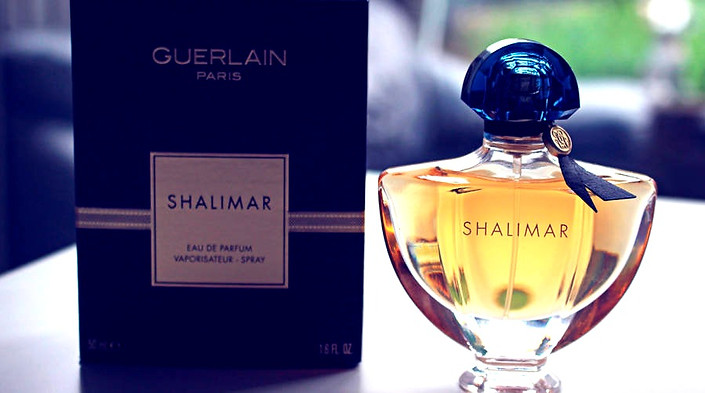
In 1925 Jacques Guerlain presented his magnum opus, Shalimar, at the International Exposition of Modern Industrial and Decorative Arts, of which Pierre Guerlain was vice president. The perfume paid tribute to the eponymous Mughal gardens and was the culmination of four years’ work. Guerlain was fifty years old. Shalimar would become the archetypal ‘oriental’ of perfumery, remaining the house's bestseller well into the 21st century. In the words of perfumer Bernard Bourgeois, "Who does not know the troubling sillage of Shalimar?"
He continued to work during the last eighteen years of his life, though created little. Increasingly he retreated to his estate in Les Mesnuls, attending to his flowerbeds, orchards and Japanese garden. His final creations include Fleur de Feu (1948), a cool aldehydic, and, four years later, the unusually coarse Atuana (a variant spelling of Atuona), named after the last resting place of painter Paul Gauguin. Ode (1955), Guerlain’s swan song created with his grandson and successor Jean-Paul Guerlain, is a conventional floral in tribute to his gardens, though it bears a resemblance to Henri Alméras’ Joy (1930).
In 1956, Guerlain reluctantly agreed to be photographed in his laboratory and country home by Willy Ronis for a special in Air France Revue. These photographs, taken at the end of Guerlain's career, offer a rare insight into his professional and personal life.
It was when working with his grandson on Chant d'Arômes, released in 1962, that Jacques Guerlain found himself incapacitated. "Unfortunately," he told his successor, "I create nothing more than perfumes for old ladies."
Weakened by a fall that fractured his femur, Jacques Guerlain died in Paris on May 2, 1963 at the age of 88. Though he was not a practicing Catholic, his funeral was held at the Church of Saint-Philippe-du-Roule two days later. He was buried alongside his son, Pierre, and father in the Passy Cemetery.
Source: wikipedia.org