

We salute them all for their classic and iconic consumer products.
We love you!
accessories


LEVI'S
original 501 jeans
The Levi’s 501 is slowly approaching its 150th birthday. America’s classic pair of denim has gone through quite the evolution since its inception in 1873. The jean today is, although a different piece of garment entirely to the nineteenth-century waist overall, still referred to by its Lot number: 501.
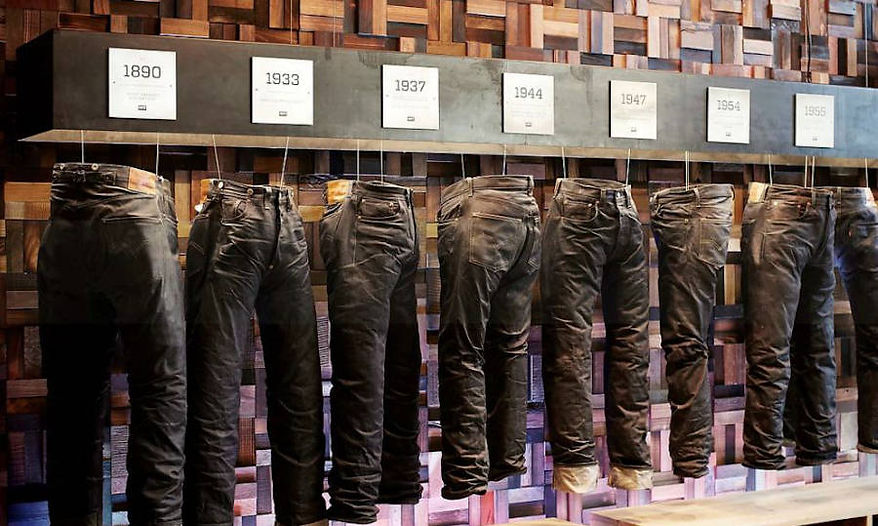
Evolution of the 501: Source: Levis
1853 – Levi Strauss arrives in San Francisco and opens a wholesale dry goods business, selling clothing, blankets, handkerchiefs, etc. to small general stores throughout the American West.
1872 – Jacob Davis, a Reno Nevada tailor, writes to Levi Strauss, telling him about the process he invented to rivet the pocket corners on men’s pants to make them stronger. He suggests the two men take out a patent on the process together and Levi agrees.
1873 – Levi Strauss & Jacob Davis are granted a patent on the process of riveting pants by the U.S. Patent and Trademark Office on May 20. It is patent number 139,121 and this is the invention of the blue jean.
The pants - called “waist overalls” - have one back pocket with the Arcuate stitching design, a watch pocket, a cinch, suspender buttons and a rivet in the crotch. The origin of the Arcuate stitching design is unknown. Stories about it representing the wingspread of a bird are myths; the loss of records in 1906 makes it impossible to know why the stitching was first used. There may have been a tradition of pocket stitching on men’s workwear but this has not been found in any research done so far. The cinch and suspender buttons were standard on men’s pants. Keep in mind that Levi's did not invent the cut or fit of the waist overalls; Levi's did however, take traditional men’s work pants and rivet them, creating the new category of workwear which we today call blue jeans.
The pants are made of 9 oz. XX blue denim, which comes from the Amoskeag Mill in Manchester, New Hampshire.
They are sewn in San Francisco, probably in a combination of factory production and home sewing. Because of the loss of historical records in the 1906 earthquake and fire it's unknown when the first factories were opened. It’s also possible Levi Strauss & Co. (LS&Co.) leased factory space in the 1870s and then opened its own factories in the 1880s.
1886 – The Two Horse brand leather patch is first used on the waist overalls. Its purpose was to demonstrate the strength of the pants and reinforce LS&Co. status as the originator of patent riveted clothing. LS&Co. knew that the patent would go into the public domain around 1890 and decided to reinforce its message of originality and strength graphically. There may also have been a tradition of some sort of patch on men’s workwear at this time, but this has been hard to research.
c1890 – The rivet patent goes into the public domain, so that Levi Strauss & Co. is no longer the exclusive manufacturer of riveted clothing. Lot numbers are first assigned to the products being manufactured. For an unknown reason, 501 is used to designate the famous copper-riveted waist overalls. LS&Co. also made a 201 jean, which was a less expensive version of the pants, as well as other products using other three-digit numbers. Because of the loss of LS&Co. records in 1906, the reasons for many of these changes are unknown.
c1901 – The pants – now just called “overalls” - now have two back pockets. It’s likely LS&Co. added this additional pocket due to consumer requests or changes in men’s fashions at the time.
1902 – Levi Strauss dies at the age of 73. His nephews take over the business; their descendants still run the company today.
1906 – The San Francisco earthquake and fire destroys the headquarters and factories of Levi Strauss & Co. A new factory is built at 250 Valencia Street in San Francisco and opens in November.
1910s – Sometime during this decade the jeans are sewn with a felled inseam. Prior to this time the inseam was “mock” felled.
1915 – The overalls win a “Highest Award” at the Panama-Pacific International Exposition in San Francisco. LS&Co. begins to buy denim from Cone Mills in Greebsboro, North Carolina.
1922 – Belt loops are added to the overalls, but the suspender buttons are still retained. The cinch is also still used on the pants, but some men cut if off in order to wear the overalls with a belt. Again, the addition of belt loops was in response to changes in men’s fashions and our understanding of what consumers wanted. LS&Co. now buys its denim exclusively from Cone Mills.
c1927 – Cone Mills develops the 10 oz. red selvage denim exclusively for the 501 jeans. The denim is woven in 29” wide looms.
1936 – The red Tab is first placed onto the right back pocket of the overalls. The word “Levi’s is stitched in white in all capital letters on one side only. The Tab is created to differentiate Levi’s overalls from the many competitors in the marketplace who were using dark denim and an Arcuate stitch. We had not yet trademarked the Arcuate so other companies were using it in direct imitation of LS&Co..
1937 – The back pockets on the overalls are sewn so that they cover the rivets. This is in response to consumers who complained that the rivets scratched furniture and saddles.
The suspender buttons are removed from the overalls. Consumers are given snap-on buttons in case they still want to wear suspenders.
World War II – Changes are made to the overalls in order to conform to rules set by the War Production Board for the conservation of raw materials. The crotch rivet, watch pocket rivets and back cinch are removed to save fabric and metal. The Arcuate stitching design is removed as the thread is decorative only and not vital to the usefulness of the garment. In order to keep the design on the pants, LS&Co. sewing machine operators paint it on each pair.
1943 – The Arcuate stitching design is registered as a trademark.
c1947 – The post-war version of the 501 jeans starts coming off the production line. The cinch is gone forever, the rivets are put back on the watch pocket and the Arcuate is now stitched with a double-needle machine which gives it the “diamond” shape at the point where the two lines of stitching meet. This creates the uniform look of the Arcuate, which is in contrast to previous years, when the single needle application gave each Arcuate design a unique appearance, depending on the skill of the operator.
Early 1950s – The word LEVI’S is now stitched on both sides of the red Tab.
1954 – A zippered version of the overalls is introduced and named 501Z. This was introduced as LS&Co. had begun selling its products on the East Coast of the United States and many people were unfamiliar with the button fly.
Late 1950s – The leather patch is replaced by a Two Horse patch made of heavy-duty card stock, known as the “leather like.” This is due to the fact that the company was selling products nationally, and it was becoming more expensive to use real leather. Also, the newer automatic washing machines were very hard on the real thing.
1960 – The word “overalls” is replaced by the word “jeans” in advertising and on packaging. LS&Co. had made other products in the past which they called “jeans” (specifically, denim pants for boys in the 1930s) but its top of the line “overalls” – 501 jeans – did not get this name until teenagers began calling the product “jeans” in the 1950s. No one really knows why the word became associated with the men’s overalls, but teenagers adopted the phrase and it became the term used by all manufacturers.
c1961 – Pre-shrunk Levi’s jeans are introduced.
1964 – The jeans become part of the permanent collections of the Smithsonian Institution in Washington, D.C.
1966 – The first television commercial for Levi’s jeans is aired.
The rivets are removed from the back pockets and replaced with bar tacking. This is due to the fact that the strong rivets eventually wore through the denim, exposing them and causing the problems (i.e. furniture scratching) that led to them being covered back in 1937.
1971 – The word “Levi’s on the red Tab device is now stitched in white with a capital “L” only; the “E” looks like it changed, leading to the vintage clothing concept of “Big E” and “little e.” This was done to conform to the company’s new housemark – the “batwing” – which was adopted in 1967 and in which the word “Levi’s” is meant to be the proper name of its founder, Levi Strauss.
1981 – 501 jeans for women are introduced, with the airing of the famous “Travis” television commercial.
1983 – Cone Mills begins to introduce XXX denim through the use of 60” wide looms.
1984 – The renowned “501 Blues” television advertising campaign is launched at the summer Olympic Games in Los Angeles.
1985 – LS&Co. wins the Governor’s Committee Media/Advertising Award from the New York State Office of Advocates for the Disabled, for its positive portrayals of disabled people in the “501 Blues” television ads.
1986 – The first in a series of innovative television commercials for the 501 jeans airs in Europe. These commercials feature classic American rock music mixed with nostalgia and romance.
1992 – Due to the interest in “vintage” Levi’s jeans on the part of consumers worldwide, LS&Co. introduces the “Capital E” jean in the United States. This also follows on the success of the vintage model created earlier by Levi Strauss Japan.
1993 – Levi Strauss & Co. sponsors the “Send Them Home Search,” a contest to find the oldest pair of Levi’s jeans in the United States. The winning pair dates to the late 1920s.
1996 – Building on the success of the Capital E product, a new series of vintage reproductions - called the Levi’s Vintage Clothing line - is introduced in stores worldwide.
1997 – LS&CO. buys a pair of c1890 501 jeans for $25,000.
1998 – The Levi’s 501 jeans celebrate 125 years of originality.
2013 – LS&CO. celebrates the 140th anniversary of the invention of the blue jean.
Today, the story continues…
Source: levis.com
